How Much Does It Cost to Build a Delivery App in 2026?
343 Views
7
min
August 14, 2026
Last Updated: August 24, 2026
Boost Your Business
with AI Powered Products!
Enter your details for expert insights and a personalized action plan.
Share
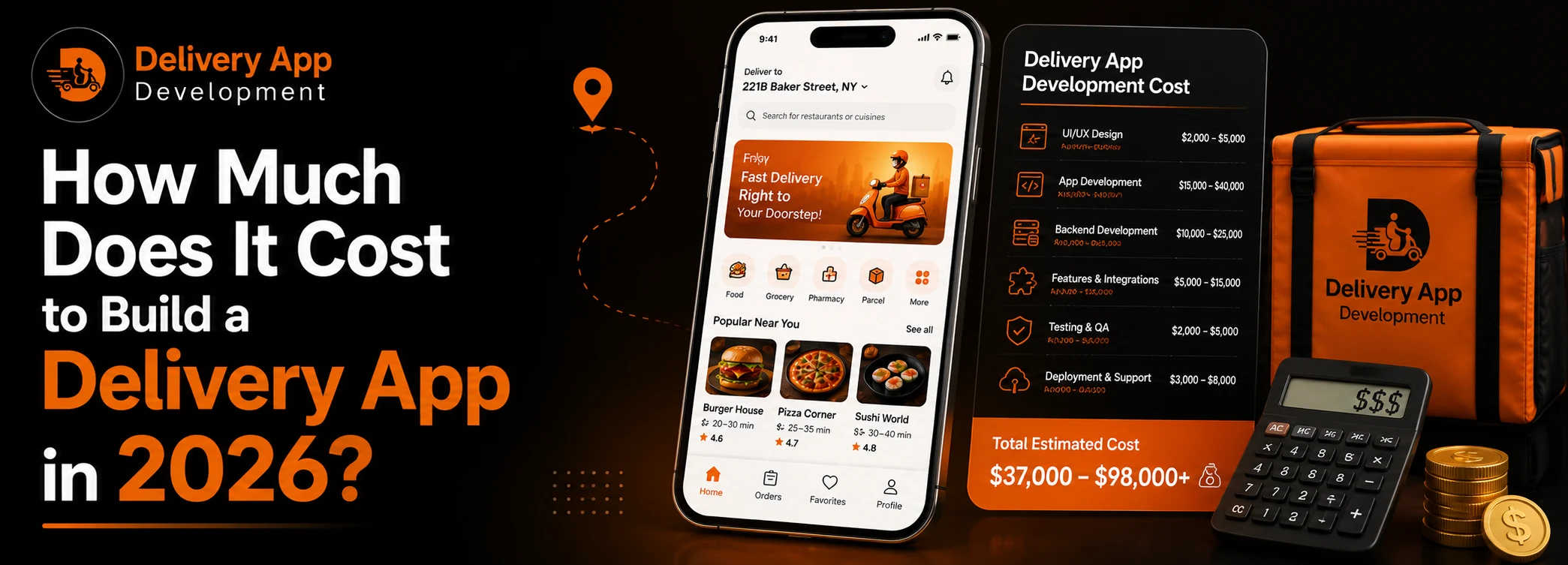
A delivery app in 2026 typically costs between $25,000 and $60,000 for a lean MVP, $60,000 to $150,000 for a full-featured single-vertical app, and $150,000 to $400,000 or more for a multi-vertical platform. The exact number depends on scope, team location, technology choices, and how many verticals you support at launch.
That range is wide on purpose, since a one-city pilot and a national platform are not the same build. This guide breaks down the assumptions a delivery app development company would use to scope your project. Recent data fromBusiness of Apps shows the food delivery sector kept expanding through 2026 amid continued consolidation, which makes an accurate budget more important than ever for new entrants.
Quick Answer Table
Project type
Typical cost range (USD)
Typical timeline
Basic MVP, single vertical, one city
$25,000 – $60,000
8–14 weeks
Full-featured single-vertical app
$60,000 – $150,000
4–7 months
Multi-vertical or multi-city platform
$150,000 – $400,000+
7–12 months
App like Uber Eats or DoorDash (full parity)
$300,000 – $700,000+
10–18 months
White-label or pre-built platform
$8,000 – $40,000 setup, plus licensing fees
2–6 weeks
No-code or low-code build
$3,000 – $20,000
2–8 weeks
These numbers assume a US-based or Western European agency rate. Teams in other regions can bring the same scope in lower, which the regional section below explains in detail.
What Is Included in a Delivery App?
Most people say “delivery app” and picture one screen. In practice, a working platform is at least four connected products.
Customer app
Browsing, ordering, payment, order tracking, and support.
Courier or driver app
Job acceptance, navigation, proof of delivery, and earnings tracking.
Merchant or vendor portal
Menu or catalog management, order acceptance, and inventory updates.
Admin dashboard
Operations, dispatch, analytics, payouts, and dispute handling.
Some projects also need a website, a call-center tool, or a separate app for warehouse staff. Each of these adds development hours, so scope them out before you ask anyone for a quote. A vague brief is the most common reason early estimates turn out wrong.
Delivery App Development Cost by Component
Breaking the build down by component makes it easier to see where the budget actually goes.
Component
Approximate share of budget
What drives the cost
Customer app (iOS + Android)
25–30%
Screens, payment flow, UX polish
Courier app
15–20%
Real-time location, navigation, offline handling
Merchant/vendor portal
10–15%
Catalog complexity, inventory sync
Admin dashboard
15–20%
Dispatch logic, analytics, reporting
Backend and APIs
20–25%
Order engine, route optimization, integrations
Design (UI/UX)
8–12%
Number of screens, branding depth
QA and testing
8–10%
Device coverage, payment and compliance testing
Project management
8–10%
Team size, timeline length
Features like real-time delivery tracking, live chat, in-app promotions, and multi-language support sit on top of this baseline. Each one is a reasonable request, but each one also adds design, backend, and testing work, so it belongs on the budget line, not treated as “included.”
Cost by Delivery Business Model or Vertical
Not all delivery apps carry the same complexity. Vertical choice changes both features and compliance load.
Food delivery app development cost tends to sit in the middle of the range. Menu management, live order status, and restaurant-side order acceptance are standard requirements, and most food delivery apps also need tipping, ratings, and promo code logic.
Grocery delivery app development cost usually runs higher than food delivery, because catalogs are larger, inventory needs to sync closer to real time, and substitution logic (what happens when an item is out of stock) adds backend complexity.
Pharmacy delivery app development cost adds a layer most other verticals skip: prescription verification, age checks, and regulatory record-keeping. Compliance work here is not optional, and it should be budgeted from day one rather than bolted on later.
Alcohol delivery app development cost carries similar compliance weight, with age verification, ID checks at the door, and region-specific licensing rules that vary by state or country.
Courier and last-mile delivery app development cost shifts the weight toward the courier and admin sides. Route optimization, multi-stop routing, and proof-of-delivery capture matter more here than catalog or menu features.
On-demand delivery app development cost for a general marketplace (anything-to-anywhere) is usually the most expensive vertical, because it needs flexible order types instead of one fixed catalog structure.
If you are trying to price an app like DoorDash or Uber Eats, know that both platforms have spent years and tens of millions of dollars on route optimization, fraud detection, and merchant tooling. A realistic first version aims for competitive core functionality, not full parity on day one.
Cost by Development Approach
Custom delivery app development gives full control over features, branding, and scalability, but it costs the most and takes the longest. This is the right choice for a business planning to differentiate on product experience or operate at scale.
White-label delivery app cost is lower upfront because the core platform already exists. You are paying for setup, branding, and configuration rather than building from zero. The tradeoff is limited flexibility and ongoing licensing fees that grow with your order volume.
No-code or low-code platforms work for very simple, low-volume pilots. They are the cheapest and fastest option, but they hit a ceiling quickly once you need custom logic, complex dispatch rules, or deep third-party integrations.
Pre-built solutions with source code access sit between white-label and custom. You get a head start on development time while retaining more control than a fully hosted white-label product.
A delivery app development company worth hiring will walk you through this decision honestly, including telling you when a white-label or no-code option is genuinely the better fit for your budget and timeline, rather than pushing a custom build by default.
Cost by Platform and Technology Choice
Is it cheaper to use Flutter or React Native than separate native apps? In most cases, yes. Building with a cross-platform framework like Flutter or React Native lets one codebase serve both iOS and Android, which typically cuts development time by 25–40% compared to two fully separate native builds.
Native development (Swift for iOS, Kotlin for Android) still makes sense when the app needs deep hardware access, top-tier performance, or heavy use of platform-specific features. For most delivery apps, the interface is standard enough that cross-platform frameworks handle it well.
Backend technology choices also affect cost. Cloud infrastructure (AWS, Google Cloud, or Azure) plus a modern framework keeps ongoing hosting costs predictable, while route optimization and mapping APIs (Google Maps, Mapbox) carry their own usage-based fees that scale with order volume, separate from the one-time development cost.
Hourly rates vary sharply by region, and this is often the single biggest factor in the final number.
Region
Typical hourly rate (USD)
Notes
United States / Canada
$100 – $180
Highest cost, strong for complex compliance needs
Western Europe
$70 – $140
Similar quality tier to North America
Eastern Europe
$35 – $70
Common middle-ground choice for cost and quality
Latin America
$30 – $65
Favorable time zones for US-based teams
South Asia (India)
$18 – $45
Lowest cost tier, wide talent pool
Southeast Asia
$20 – $50
Growing outsourcing hub
An in-house team gives the most control but carries salary, benefits, and management overhead that a freelance or agency model avoids. A freelance team can be cheaper per hour but harder to manage at scale, especially across time zones. An agency model, including working with a specialized delivery app development company, usually costs more per hour than freelancers but comes with project management, QA, and accountability built in, which reduces the risk of scope creep and missed deadlines.
Hidden and Recurring Costs
The development invoice is rarely the last bill. Several costs only show up after launch.
Third-party API fees for maps, SMS/OTP verification, and push notifications, billed per use and scaling with order volume.
Payment gateway fees, typically 1.5–3% per transaction, plus setup and compliance costs for handling cards and digital wallets.
Cloud hosting and storage, which grow as order volume and data retention increase.
App store fees, including Apple’s and Google’s developer account costs and revenue-share policies.
Customer support tooling, chat and ticketing systems for both customers and couriers.
Security and compliance updates, especially for apps handling payment data or regulated goods like pharmacy or alcohol orders.
Ongoing bug fixes and OS updates, needed every time Apple or Google ships a major platform update.
How Much Does It Cost to Maintain and Scale a Delivery App?
Plan for 15–25% of the original development cost per year in maintenance, covering bug fixes, security patches, and minor feature updates. Scaling costs are separate and tend to rise with order volume rather than time: more orders mean more API calls, more support tickets, and more infrastructure capacity. A platform doing 500 orders a day and one doing 50,000 orders a day will have very different monthly operating costs, even if the original app was identical.
Timeline and Development Stages
Stage
Typical duration
Discovery and scoping
1–3 weeks
UI/UX design
3–6 weeks
Backend and API development
6–12 weeks
Frontend development (customer, courier, merchant apps)
8–16 weeks
QA and testing
3–6 weeks
App store submission and launch prep
1–2 weeks
How long does it take to build a delivery app? A basic MVP typically takes 8–14 weeks. A full-featured single-vertical app usually takes 4–7 months. A multi-vertical or multi-city platform can take 7–12 months or longer, particularly when compliance requirements add extra review cycles.
How to Reduce Cost Without Damaging the Product
Launch with one vertical and one city. Expansion is a feature you can add once the core product proves itself, not something to build speculatively on day one.
Cut features that don’t affect the core order loop. Loyalty programs, referral systems, and advanced analytics can wait for version two.
Choose cross-platform development unless there’s a specific technical reason to go native.
Use existing APIs instead of building from scratch for maps, payments, and notifications. Building your own version of Google Maps is never the right call for a delivery startup.
Get a detailed, itemized quote before committing. A vague quote from any delivery app development company almost always means change orders and cost overruns later. Ask for a breakdown by component, similar to the table earlier in this guide, so you can see exactly where the money goes.
Test with real users early, even before every planned feature is built. Feedback from a working MVP is worth more than another month of feature development based on assumptions.
Conclusion
There is no single correct answer to “how much does it cost to build a delivery app,” because the honest answer depends on your vertical, your feature list, your chosen development approach, and where your development team is based. What you can control is the quality of your planning. A clear scope, a realistic feature list for version one, and an itemized quote from a qualified delivery app development company will get you a number you can actually plan around, rather than a figure that falls apart once development starts.
If your project needs a country-specific cost breakdown, currency conversion, or region-specific compliance detail, share the target country and this guide can be adapted accordingly.
Frequently Asked Questions(FAQs)
A basic single-vertical MVP typically costs between $25,000 and $60,000, covering a customer app, a courier app, and a simple admin panel.
Real-time tracking, route optimization, multi-vertical catalogs, and compliance features like age verification or prescription checks add the most development time and cost.
It depends on budget and differentiation goals. White-label platforms launch faster and cost less upfront, while custom apps cost more but offer full control over features and scalability.
Rates range from roughly $18–$45 per hour in South Asia to $100–$180 per hour in North America, with Eastern Europe and Latin America often used as a middle-cost option.
Payment gateway fees, mapping and SMS API costs, cloud hosting, app store fees, and ongoing maintenance, typically 15–25% of the original build cost per year.
With over 20+ years of experience in driving global digital initiatives, Nikhil Bansal is the CEO & Director of Apptunix. He specializes in orchestrating large-scale digital transformations, enterprise-grade software solutions, and high-level business strategies that redefine industry standards. Nikhil is known for his ability to bridge the gap between complex business challenges and innovative technology, helping Fortune 500 companies and startups alike achieve sustainable growth. A visionary leader, he empowers enterprises to navigate the digital landscape with agile, ROI-focused models and future-ready business strategies.
Subscribe to Get Search Free Updates on Upcoming Tech Stories.
Ready to Launch Your Delivery Platform?
Turn your delivery business idea into a scalable, AI-powered platform with an engineering team trusted by startups, enterprises, and global brands.
Why Partner With Our Experts?
Faster Development
AI-powered workflows help accelerate planning, development, and testing.
Complete Delivery Ecosystem
Customer app, driver app, merchant panel, dispatcher, and admin dashboard.
Built to Scale
Secure, flexible architecture designed for growing orders, users, and operations.
Get a free consultation and expert response within 30 minutes.
Or email us directly at sales@apptunix.com


 August 14, 2026 Last Updated: August 24, 2026