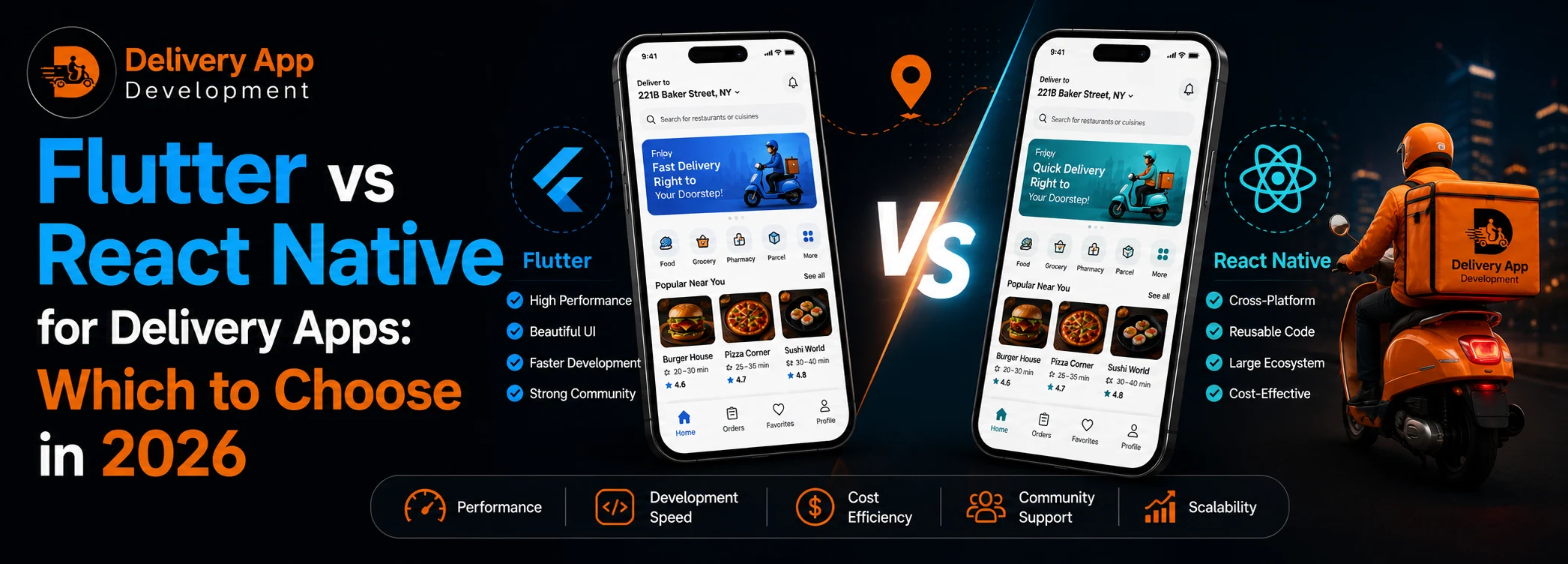
Flutter vs React Native for Delivery Apps: Which to Choose in 2026
361 Views
9
min
August 26, 2026
Last Updated: August 26, 2026
Boost Your Business
with AI Powered Products!
Enter your details for expert insights and a personalized action plan.
Share
A delivery app looks simple from the customer’s side browse, order, track, receive. Underneath that simplicity sits a technical decision that quietly moves your budget by tens of thousands of dollars.
It’s also the decision that determines whether your live tracking screen feels instant or sluggish which cross-platform framework you build on.
Most founders ask “how much will this cost?” before they ask “Flutter or React Native?” In practice, those are the same question.
The on-demand delivery software market is on track to reach roughly $632 million in 2026 and grow at a 9% CAGR through 2035. Mobile apps already account for over 82% of all food delivery orders. That growth is exactly why getting the framework decision right, early, has real financial consequences.
This guide breaks down what actually separates Flutter and React Native for delivery-specific use cases real-time GPS tracking, courier apps, order management, and multi-app ecosystems so you can budget accurately instead of guessing.
Why the Framework Decision Matters Before You Talk Budget
Before comparing frameworks, get clear on what you’re actually pricing. A delivery platform is rarely “one app.”
It’s usually three, a customer-facing ordering app, a driver or courier app with navigation and earnings tracking, and an admin dashboard for restaurants, stores, or dispatchers.
Each has different demands. The customer app needs a polished checkout flow. The courier app needs battery-efficient background location tracking. The admin panel needs real-time fleet visibility.
The framework affects all three, but not equally. Flutter and React Native both let you share most of your code between iOS and Android, which is why cross-platform development typically runs 30–50% cheaper than separate native builds.
But “cross-platform” doesn’t mean “interchangeable.” The two frameworks solve the same problem differently, and that difference shows up more in delivery apps than almost any other category, because of how heavily they lean on live location data.
This is exactly the kind of scoping question worth settling before you brief a team. Many founders bring in an experienced on-demand delivery app development company at this stage not to pick Flutter or React Native for you, but to map the three-app structure and real-time requirements so the framework decision has something solid to sit on.
Flutter vs React Native for Delivery Apps: The Fundamental Differences
Flutter, built by Google, uses the Dart language and ships its own rendering engine. It draws every pixel itself rather than relying on native UI components.
React Native, built by Meta, uses JavaScript or TypeScript. It renders through actual native components via a bridge, now largely replaced by the newer JSI-based architecture.
Factor
Flutter
React Native
Language
Dart
JavaScript / TypeScript
Rendering
Custom engine (Skia/Impeller), pixel-identical on both platforms
Neither framework is objectively “better” in the abstract. They trade off differently depending on what your delivery app needs to do well.
Flutter vs React Native Performance for Delivery Apps
Delivery apps are unusually performance-sensitive. A courier screen redrawing a moving map pin, an ETA recalculating live, and a driver list updating every few seconds all stress the UI thread constantly.
This is where framework architecture actually becomes visible to users.
Because Flutter compiles ahead-of-time to native code and draws its own UI, it tends to handle sustained, animation-heavy screens with fewer dropped frames. Independent benchmarking on mid-range Android hardware has shown Flutter rendering list-heavy screens roughly 15–20% faster than React Native, with lower CPU and memory use during scrolling.
Google’s newer Impeller rendering engine reportedly cuts frame rasterization time by around 50% versus Flutter’s older engine a direct benefit for map and tracking screens.
React Native has closed much of this gap with its newer architecture (Fabric, JSI, TurboModules). For standard business logic menus, checkout, order history, notifications users won’t notice a difference either way.
Its remaining edge is native module access. Background GPS, hardware integrations like Bluetooth receipt printers, and platform-specific notification behavior are often easier to wire up because React Native leans on native components directly, rather than routing everything through a custom engine.
Flutter vs React Native for Real-Time Delivery Tracking
Real-time tracking is the single feature most likely to make or break a delivery app’s user experience. It deserves its own decision point rather than being folded into general “performance.”
Live tracking screens combine three demanding tasks at once continuous GPS polling, socket-based data updates, and animated map redraws often while the app runs in the background.
Flutter’s rendering consistency tends to produce smoother pin movement, which is why some teams building fleet-tracking dashboards choose it specifically for that reason. React Native, by contrast, has more mature, battle-tested community libraries for background location services, built up over a decade of ride-hailing and logistics apps using the framework.
In practice, both frameworks power production apps with live tracking today. DoorDash, for example, is widely reported to run React Native across its consumer iOS and Android apps, while Flutter has become a common choice for newer fleet-tracking builds that prioritize animation smoothness.
The deciding factor is usually less “which framework is faster” and more “which one your team can implement correctly.” A mediocre build in the faster framework still loses to a well-optimized build in the other.
Here’s where founders most often under-budget the framework itself has only a modest effect on hourly rates, but a large effect on how many hours the build takes.
Blended cross-platform development rates generally run $25–$49/hour at the lower end of the global market and $75–$250/hour for established agencies in the US, UK, and Western Europe, regardless of whether the team works in Flutter or React Native.
Cross-platform MVPs with core features (auth, catalog, checkout, 8–12 screens) have a reported median cost around $76,000. That figure rises to roughly $118,000 once real-time data features are added which almost every delivery app requires from day one.
Build scope
Approximate cost range (2026)
Single-app MVP, core ordering flow only
$35,000 – $80,000
Full delivery platform (customer + courier + admin apps)
$90,000 – $250,000
Enterprise-grade platform with AI routing, multi-vendor logistics, advanced analytics
$250,000 – $500,000+
A few cost realities apply regardless of framework:
You’re pricing three apps, not one. Customer, courier, and admin interfaces each need their own QA cycles even when code is shared.
QA typically eats 15–25% of the budget. Delivery apps fail publicly and expensively when GPS accuracy, payment edge cases, or push notifications aren’t tested across devices.
Post-launch maintenance runs 15–25% of build cost annually. Map SDKs, payment gateways, and OS updates all require ongoing upkeep.
Flutter and React Native developer rates are close enough that talent supply, not hourly rate, usually decides total cost which is the next factor worth understanding.
Talent Pool, Hiring Speed, and Long-Term Maintenance
This is the most underrated line item in a delivery app budget. React Native’s talent pool is significantly larger, driven by its use of JavaScript, one of the most widely known languages in the world.
Job data reflects that: React Native postings outnumber Flutter postings by roughly 6-to-1 on major job boards. If you need to scale a team fast, or hand the app to an in-house web team that already knows JavaScript, that pool matters.
Flutter’s community is smaller but has grown fast. As of mid-2026, its GitHub repository had around 178,000 stars versus roughly 126,000 for React Native.
Statista’s developer survey put Flutter ahead at 46% versus 35% among developers who use cross-platform tools. That figure reflects self-reported usage, not a share of production apps it shouldn’t be read as “46% of delivery apps run on Flutter.”
Satisfaction scores for both frameworks are close and high, so retention isn’t a strong differentiator either way.
For maintenance, the practical question is who will still be available to support this app in three years? React Native’s larger pool makes replacing a departing developer faster and cheaper.
Flutter’s smaller pool can mean longer hiring cycles, but teams that do find Flutter developers often report fewer platform-specific bugs, since one codebase renders identically on both platforms.
Flutter vs React Native for Food Delivery Apps
Food delivery apps live or die on speed of browsing and checkout, not just tracking. Menus with variants, add-ons, and real-time restaurant availability create UI states that need to render fast on the low-cost Android devices that still make up the bulk of the market outside North America.
Flutter tends to be the more forgiving choice here, since its consistent rendering cuts down on low-end-device issues teams have to chase individually.
React Native remains strong if you already have a JavaScript/React team, want to share logic with a web ordering platform, or need deep POS and kitchen-display integrations, where its native module ecosystem is more mature.
Production food delivery apps and countless open-source clones used as starting points exist in both frameworks. That alone tells you the category doesn’t force one “correct” answer.
Flutter vs React Native for On-Demand Delivery Apps and Courier Apps
Courier and logistics apps put more weight on background processes than food ordering does location updates while the app is minimized, battery efficiency over an 8-to-10-hour shift, offline order queuing in low-signal areas, and reliable job-assignment notifications.
React Native’s deeper native-module maturity gives it a practical edge for background location and battery-efficient GPS polling areas developers have refined for over a decade.
Flutter has closed much of this gap with official and community packages. Still, teams should budget extra QA time for background-location edge cases if choosing Flutter for a courier-heavy app, since fewer battle-tested reference implementations exist.
If the courier experience is the core of your product grocery, parcel, or B2B last-mile delivery weigh this maturity gap seriously before committing.
Best Framework for Delivery App Development: A Decision Checklist
There’s no universal winner. The right framework depends on your team and your app’s specific pressure points. Use this as a quick gut check:
Lean Flutter if:
You’re starting fresh with no existing JavaScript team
Pixel-perfect, animation-heavy UI (live maps, order tracking, custom branding) is a priority
You want to eventually extend to web or desktop admin tools from the same codebase
Your primary market runs on lower-end Android devices
Lean React Native if:
Your team already knows JavaScript/TypeScript or React
You need the widest possible hiring pool for fast scaling or contractor flexibility
Heavy native-module work (background GPS, POS integrations, hardware) is central to the app
You want to share code or logic with an existing web ordering platform
Either framework works fine if:
Your MVP is primarily a standard ordering-and-tracking flow without unusual technical demands
You’re validating a business model before optimizing for scale
Budgeting Mistakes That Quietly Inflate Delivery App Costs
Founders rarely blow their budget on the framework itself. They blow it on what they forgot to scope around it:
Pricing one app instead of three. Customer, courier, and admin interfaces all need design, development, and QA time.
Treating real-time tracking as a “feature,” not core infrastructure. Sockets, map SDKs, and location accuracy testing should be scoped from day one.
Skipping the maintenance line item. Map providers, payment gateways, and OS updates require ongoing spend budget 15–25% of build cost annually.
Underestimating QA for GPS-heavy screens. Location bugs are device- and carrier-specific; they surface after launch, not in a demo.
Choosing a framework on marketing claims rather than team fit. The “faster” framework on a benchmark loses to the framework your team can actually ship well.
Flutter vs React Native: Which Is Better for Delivery Apps? (Final Verdict)
If you want a single, pixel-consistent UI across a customer app, courier app, and admin dashboard, Flutter is generally the stronger technical fit for delivery and real-time tracking specifically.
If your priority is hiring speed and deep native integrations with hardware or POS systems, React Native remains a safe, proven choice proven partly because it already powers major platforms in this exact category.
For most founders, team composition should decide this more than the framework’s specs. A skilled team ships a fast, reliable delivery app in either Flutter or React Native; an under-scoped project struggles in both.
Get the budget, the three-app scope, and the real-time tracking requirements right first. Then pick the framework that matches the team you can actually build.
Frequently Asked Questions(FAQs)
Flutter generally performs better for animation-heavy, real-time tracking screens, while React Native offers a larger talent pool and stronger native-module support for GPS and hardware integrations. The right choice depends more on your team’s existing skills and your app’s specific technical priorities than on either framework being universally superior.
Framework choice has a minor effect on hourly rates, which run roughly $25–$250/hour depending on team location and seniority. The bigger cost driver is scope: a full delivery platform with customer, courier, and admin apps typically costs $90,000–$250,000, while a basic single-app MVP can run $35,000–$80,000 in either framework.
Flutter’s rendering engine generally produces smoother map animations and pin movement in benchmark testing, while React Native has more mature, community-tested libraries for background location tracking. Both are used successfully in production tracking apps today.
React Native’s larger developer pool typically makes it faster and cheaper to hire replacement developers over time. Flutter’s single rendering engine can mean fewer platform-specific bugs to fix, which can offset a smaller hiring pool. Budget 15–25% of your original build cost annually for maintenance regardless of framework.
Technically yes, but it means a substantial rebuild rather than a migration, since the two frameworks don’t share code or architecture. Most teams treat this as a “start over” decision and only do it when the original framework is actively blocking growth, not as a routine change.
Both frameworks power major production delivery apps. React Native has historically been more common given its longer track record and larger ecosystem, but Flutter has gained significant ground in newer builds, particularly for apps prioritizing tracking-screen performance and multi-platform reach.
Timelines are driven more by scope than framework: a focused MVP typically takes 3–5 months, while a full three-app platform with real-time tracking, payments, and admin tools usually takes 6–9 months. Flutter’s single codebase can shave some time off cross-platform QA, but the difference is usually smaller than founders expect.
In almost all cases, yes. Combining these into one app creates a confusing experience and unnecessary permissions complexity. Budget and plan for three distinct interfaces customer app, courier/driver app, and admin or vendor dashboard even if they share a significant amount of backend and component code.
With over 20+ years of experience in driving global digital initiatives, Nikhil Bansal is the CEO & Director of Apptunix. He specializes in orchestrating large-scale digital transformations, enterprise-grade software solutions, and high-level business strategies that redefine industry standards. Nikhil is known for his ability to bridge the gap between complex business challenges and innovative technology, helping Fortune 500 companies and startups alike achieve sustainable growth. A visionary leader, he empowers enterprises to navigate the digital landscape with agile, ROI-focused models and future-ready business strategies.
Subscribe to Get Search Free Updates on Upcoming Tech Stories.
Ready to Launch Your Delivery Platform?
Turn your delivery business idea into a scalable, AI-powered platform with an engineering team trusted by startups, enterprises, and global brands.
Why Partner With Our Experts?
Faster Development
AI-powered workflows help accelerate planning, development, and testing.
Complete Delivery Ecosystem
Customer app, driver app, merchant panel, dispatcher, and admin dashboard.
Built to Scale
Secure, flexible architecture designed for growing orders, users, and operations.
Get a free consultation and expert response within 30 minutes.
Or email us directly at sales@apptunix.com


 August 26, 2026 Last Updated: August 26, 2026