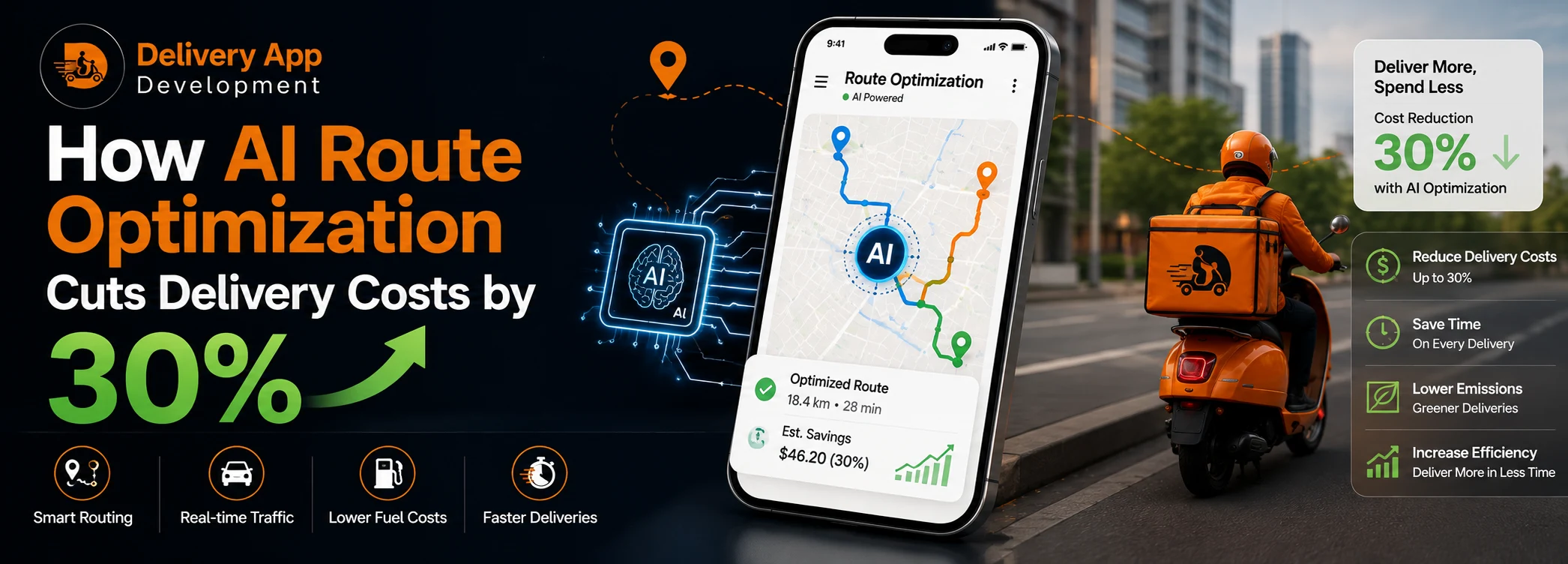
How AI Route Optimization Cuts Delivery Costs by 30%
383 Views
8
min
August 24, 2026
Last Updated: August 24, 2026
Boost Your Business
with AI Powered Products!
Enter your details for expert insights and a personalized action plan.
Share
Delivery costs don’t spike all at once. They leak out through hundreds of small inefficiencies a driver circling the same block twice, a route planned at 6am that’s obsolete by 9am, a truck running half-empty because no one recalculated the load.
Route optimization for logistics has always tried to fix this. What’s changed is that AI can now do it continuously, not once a day.
The global route optimization software market is projected to grow from $8.98 billion in 2026 to $16.78 billion by 2031, a sign that this has moved well past early-adopter territory. Last-mile delivery now accounts for 53% of total shipping costs, up from 41% in 2018 which is exactly the part of the journey AI route optimization targets hardest.
This article breaks down where the “cuts costs by 30%” claim actually comes from, how AI-powered route planning works day to day, and what to look for before you buy delivery route optimization software.
Why Delivery Costs Are Spiraling and Why Routing Is the Fix
Fuel, labor, and vehicle wear make up most of a delivery operation’s cost base. All three are driven by one variable, how many miles a vehicle drives to complete its stops.
Traditional route planning builds a schedule once, usually the night before or first thing in the morning. It then holds that plan fixed all day, regardless of what actually happens on the road.
Traffic, cancellations, new orders, and driver absences all invalidate part of that plan within hours. Manual dispatchers patch the gaps, and the cost shows up as overtime, rush shipments, and missed delivery windows.
Dynamic route optimization solves this by continuously reworking the plan as conditions change, instead of treating the morning’s schedule as final.
What Is AI Route Optimization Software?
AI route optimization software is a system that calculates the most efficient sequence of stops for a vehicle or fleet, using live data instead of fixed assumptions.
It pulls in traffic conditions, delivery time windows, vehicle capacity, driver shift limits, and sometimes weather, then runs those variables through an optimization algorithm to produce a route.
This differs from a standard GPS app in one key way a GPS app tells you how to get from A to B. AI delivery route optimization decides the best order to visit A, B, C, and every other stop, then adjusts that order in real time as new information arrives.
How AI-Powered Route Planning Works: Static vs Real-Time
Static routing plans once and sticks to it. It’s essentially a spreadsheet with directions attached, and it was the industry standard for decades.
AI-powered route planning works differently. It treats the route as a living plan that gets re-evaluated continuously, not a document that’s finalized before the first delivery.
Real-time route optimization pulls in live signals a traffic incident, a new order, a driver running behind and re-slots stops into the most efficient position within seconds. Traditional dispatchers spend 10 to 20 minutes making the same kind of adjustment manually.
That speed difference compounds. A route optimized once in the morning degrades in efficiency as the day goes on. A route re-optimized continuously stays close to its theoretical best the entire shift.
No single lever produces a 30% delivery cost cut on its own. The number comes from stacking several smaller, well-documented savings on top of each other.
Cost lever
Typical AI-driven reduction
What drives it
Fuel consumption
10–20%
Fewer miles driven, less idling, smarter stop sequencing
Transportation cost overall
15–25%
Combined effect of fuel, labor, and fleet utilization
Late/failed deliveries
Up to 30% fewer
Real-time rerouting around delays before they cascade
Dispatcher/planning time
10–20 minutes saved per change
Automatic re-slotting instead of manual replanning
Independent research backs the range rather than a single fixed figure. McKinsey’s analysis of AI-driven multi-constraint routing found a 10–25% cost reduction versus a static daily plan, and separate McKinsey supply chain research reported roughly 30% fewer late shipments among companies deploying AI broadly across logistics operations. DHL’s Greenplan dynamic routing algorithm is reported to have cut delivery costs by 20% on its own.
The realistic takeaway: “up to 30%” is achievable, but it’s the ceiling for a mature deployment that combines fuel savings, labor efficiency, and fewer failed deliveries not a guaranteed day-one result.
Last-Mile Route Optimization: The Biggest Opportunity in Delivery
Last-mile delivery optimization gets the most attention for a simple reason it’s the most expensive and least efficient leg of the entire supply chain.
Long-haul routes between warehouses are relatively predictable and easy to plan well in advance. The last mile is the opposite dozens of stops, tight time windows, unpredictable traffic, and customers who aren’t always home.
AI route optimization software is particularly effective here because it can process all of those variables at once and re-plan instantly when one of them changes. A missed delivery window, a customer reschedule, or a new same-day order all get absorbed into the existing route rather than triggering a separate, costly trip.
For businesses running food, grocery, or parcel delivery, this is usually where the ROI shows up first and fastest.
Fleet Route Optimization for Multi-Vehicle Operations
Fleet route optimization adds a layer of complexity single-driver routing doesn’t have balancing load across multiple vehicles, driver shift limits, and vehicle capacity at the same time.
A well-optimized fleet plan doesn’t just find the shortest route for each vehicle. It decides which vehicle should take which stops in the first place, so no truck runs half-empty while another is overloaded.
Modern platforms increasingly treat owned drivers, contracted third-party capacity, and gig-economy riders as one combined capacity pool, assigning each delivery to whichever resource is cheapest and fastest at that moment. That’s a meaningfully harder optimization problem than routing a single vehicle, and it’s where AI’s ability to process many variables simultaneously matters most.
AI Logistics Optimization Beyond the Route Itself
Route optimization for logistics doesn’t stop at directions. The same AI models that plan routes are increasingly used for demand forecasting, predictive maintenance, and load planning.
Predictive maintenance uses vehicle sensor data to flag mechanical issues before they cause a breakdown mid-route, avoiding the cascading delays a single broken-down vehicle can cause. Demand forecasting analyzes historical order data to predict delivery volume by area and time window, so fleets are positioned correctly before demand spikes rather than reacting to it.
Together, these layers turn AI logistics optimization into something closer to a control tower for the entire delivery operation, not just a smarter version of turn-by-turn navigation.
Choosing Route Optimization Software for Delivery: What to Look For
Not all delivery route optimization software is built for the same job. A tool designed for long-haul freight planning won’t necessarily handle dense, time-windowed last-mile stops well, and vice versa.
Before evaluating vendors, get clear on a few requirements:
Real-time re-optimization, not just next-day route planning
Multi-constraint support for time windows, vehicle capacity, and driver shift rules
Integration with your existing stack order management, fleet telematics, and your customer-facing delivery app
Transparent reporting on miles saved, cost per stop, and on-time performance, so ROI is measurable rather than assumed
Scalability from a handful of vehicles to a full multi-depot fleet, if growth is part of the plan
This is also a point where the routing decision and the app decision start to overlap. Businesses building or rebuilding their delivery experience often bring in an on-demand delivery app development company to make sure the customer app, the driver app, and the routing engine are architected to share data in real time rather than bolting an AI optimization layer onto a system that was never built to handle live updates.
Real-World Results: What Companies Are Actually Seeing
UPS’s ORION system is the most-cited example in the industry, reportedly saving the company $300–400 million annually on an initial investment of around $250 million a payback that repeats itself many times over.
Companies adopting AI route optimization more broadly report 15–25% reductions in transportation costs and 10–20% fuel savings, typically reaching ROI within three to six months. DHL’s internal benchmarks show a 12% reduction in total transportation spend across its European network from AI-powered routing alone.
Adoption still has room to grow. AI route optimization is estimated to be in active use across only around 12% of logistics companies today, despite the documented returns often simply because switching from a familiar manual process feels riskier than it is.
Implementation Cost and ROI Timeline
Delivery route optimization software is typically priced per vehicle or per route, per month, which makes the investment scale naturally with fleet size rather than requiring a large upfront commitment.
Smaller fleets can expect to see measurable fuel and time savings within the first few weeks of deployment, since the software is reallocating existing miles more efficiently rather than requiring new infrastructure. Larger, multi-depot operations take longer to fully optimize, since fleet-wide load balancing needs a few months of real order data to tune properly.
Most companies report payback within three to six months once fuel, labor, and reduced late-delivery penalties are counted together.
Common Mistakes That Blunt the Savings
Treating it as a one-time setup: Static configuration undermines the entire point of real-time route optimization.
Not integrating with live order data: A routing engine that isn’t connected to your order and fleet systems in real time can’t actually re-optimize dynamically.
Ignoring driver adoption: Even the best AI-powered route planning fails if drivers override it or don’t trust the suggested route.
Measuring only fuel savings: Labor efficiency and reduced failed-delivery costs are often the larger share of total savings.
Choosing software sized for a different problem: Long-haul freight tools and dense last-mile tools solve different optimization problems mismatch here quietly caps your results.
Conclusion: Is AI Route Optimization Worth It?
The 30% figure is real, but it’s a ceiling built from several smaller wins stacked together fewer miles driven, fewer failed deliveries, less overtime, and faster dispatcher decisions. Most businesses land somewhere in the 10–25% range in year one, with the top end reserved for mature, well-integrated deployments.
Given that last-mile delivery already eats over half of total shipping costs for most operations, even the conservative end of that range is a meaningful line item to recover. The real decision isn’t whether AI route optimization works the data on that is settled. It’s whether your current systems are set up to actually feed it real-time data, or whether that groundwork needs to happen first.
Frequently Asked Questions(FAQs)
Documented results generally fall in the 10–25% range for transportation costs, with fuel savings of 10–20% and up to 30% fewer late or failed deliveries in mature deployments. The often-cited “30%” figure reflects the combined effect of several savings levers, not a single guaranteed number.
Static routing plans once, usually the night before, and holds that plan fixed regardless of what happens during the day. Real-time route optimization continuously re-evaluates the plan as traffic, orders, and delays change, keeping the route close to optimal throughout the shift.
A GPS app calculates directions between two points you’ve already chosen. AI route optimization software decides which stops to visit in what order across an entire route or fleet, factoring in time windows, vehicle capacity, and live conditions.
Most companies report measurable savings within the first few weeks and full payback within three to six months, once fuel, labor, and reduced late-delivery costs are combined. Larger multi-depot fleets typically take longer to fully tune.
It works for both pricing usually scales per vehicle, so smaller fleets aren’t priced out. Smaller operations often see savings faster since there’s less operational complexity to reconfigure.
Yes, and it should. The routing engine needs to share live order and location data with both the customer-facing app and the driver app to actually re-optimize in real time treating it as a bolt-on feature instead of integrated infrastructure is one of the most common reasons deployments underperform.
At minimum, delivery addresses and time windows, vehicle capacity and shift constraints, and live traffic data. More mature deployments also feed in historical order patterns and vehicle telematics for predictive maintenance and demand forecasting.
No, it applies to fleet route optimization more broadly, including field service, long-haul logistics, and multi-depot distribution. Last-mile delivery simply sees the largest relative gains, since it’s the most expensive and least predictable leg of most supply chains.
Reena Bhagat, the CTO and Head of AI at Apptunix, is a seasoned technology strategist with a deep-rooted expertise in emerging technologies. With a focus on AI/ML integration, product engineering, cloud management, she leads the technical vision for high-performance SaaS infrastructures. Reena is recognized for building secure, scalable, and decentralized systems that solve real-world complexities. Her passion lies in leveraging data science and future-tech to create resilient digital products, making her a trusted authority for organizations looking to lead in the age of intelligent automation.
Subscribe to Get Search Free Updates on Upcoming Tech Stories.
Ready to Launch Your Delivery Platform?
Turn your delivery business idea into a scalable, AI-powered platform with an engineering team trusted by startups, enterprises, and global brands.
Why Partner With Our Experts?
Faster Development
AI-powered workflows help accelerate planning, development, and testing.
Complete Delivery Ecosystem
Customer app, driver app, merchant panel, dispatcher, and admin dashboard.
Built to Scale
Secure, flexible architecture designed for growing orders, users, and operations.
Get a free consultation and expert response within 30 minutes.
Or email us directly at sales@apptunix.com


 August 24, 2026 Last Updated: August 24, 2026