Pickup and Delivery App Development: A Complete Guide (2026)
303 Views
10
min
August 5, 2026
Last Updated: August 24, 2026
Boost Your Business
with AI Powered Products!
Enter your details for expert insights and a personalized action plan.
Share
The global last-mile delivery market hit $167.36 billion in 2025 and is heading toward $348.85 billion by 2033. Demand is real, and it’s growing.
84% of shoppers ditch a retailer after just one bad delivery. So your app is your reputation.
A basic Pickup and Delivery App Development MVP starts around $25,000–$60,000. Enterprise builds run $150,000+.
Winning apps sync three panels flawlessly: customer, driver, and admin.
AI routing, real-time tracking, and hyperlocal fulfillment are no longer “extras.” They’re the price of entry.
The last-mile delivery sector has become one of the most active areas of investment in technology today. Customer expectations around speed and visibility have shifted permanently: people no longer wait passively for an order; they expect to track it in real time, much like a live status feed.
This shift is reflected in the market data. The global last-mile delivery market reached $167.36 billion in 2025 and is projected to grow to $348.85 billion by 2033, according toGrand View Research. The demand signal is clear, and the opportunity for well-executed platforms is substantial.
This guide covers the essentials of building a pickup and delivery app: business models, core features, realistic 2026 costs, the development process, and how to select the right development partner.
What Is Pickup and Delivery App Development?
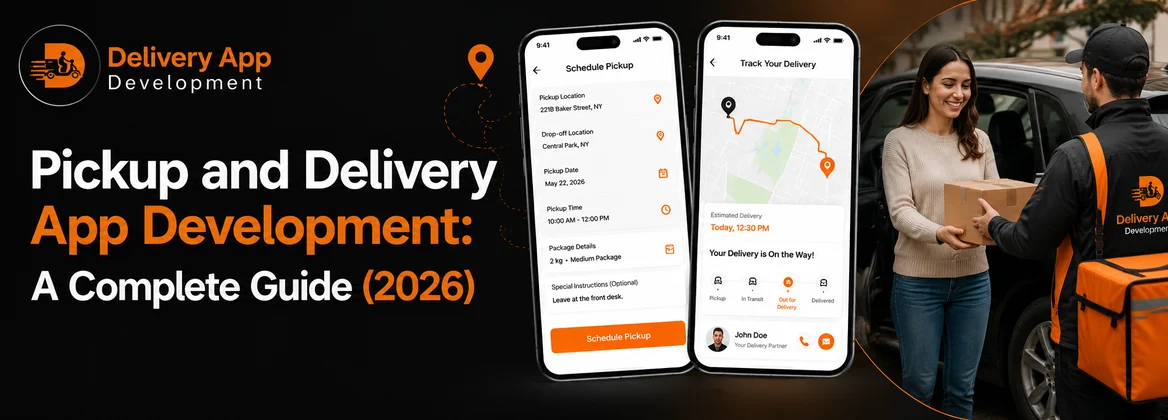
Pickup and delivery app development is the process of building a digital platform that coordinates the movement of goods from origin to destination. A customer requests a pickup, a driver accepts and fulfills it, and the customer tracks progress in real time.
In practice, a complete solution consists of three interconnected components rather than a single app:
Customer app: Where users place orders, complete payment, and track deliveries.
Driver app: Where couriers accept jobs, navigate routes, and confirm completed deliveries.
Admin panel: The operational control center for managing fleets, orders, and performance data.
The quality of a delivery platform depends less on any single interface and more on how seamlessly these three components communicate. When integration is weak, the failure points compound quickly, stalled orders, driver confusion, and a rise in support volume. The core engineering challenge, then, is less about the map on screen and more about the coordination layer running beneath it.
Why Are Founders and Investors Pouring Money Into Delivery Apps Right Now?
Because customer patience has quietly collapsed. And that shift changed the entire game.
Speed used to be a bonus feature. Now it’s the baseline. In fact, 80% of consumers treat same-day delivery as a standard expectation, while 77% want certain orders within two hours. Meanwhile, according to Statista, the online food delivery market alone is projected to hit $1.51 trillion in 2026. That’s just one slice of the pie.
Still, the scariest number isn’t about speed. It’s about loyalty. Research from the MIT Center for Transportation & Logistics found that 84% of consumers would abandon a retailer after a single poor delivery experience. On top of that, 65% walk away after two or three late deliveries.
So let that sink in. Your delivery experience isn’t a back-office task. It’s your brand’s first impression and its last chance, all at once.
There’s a cost angle too. Last-mile delivery now eats up 53% of total shipping costs, up from 41% in 2018. Plus, McKinsey estimates inefficient handovers waste up to $95 billion a year in the US economy alone. Therefore a smart app doesn’t just win customers. It also plugs a very expensive leak.
That combination is exactly why every seriousDelivery App Development Company is booked out right now. The demand is loud, and the margins reward whoever gets it right.
Which Business Model Should Your Delivery App Run On?
Before you design a single screen, pick your model. Because this one decision shapes your costs, your risk, and how fast you can scale.
Here are the five that dominate today.
Aggregator model
You connect customers to local vendors and take a cut. There’s no inventory to hold, so it’s lighter to launch. Think of it as the matchmaker approach.
End-to-end model
You own the whole chain, from warehouse to doorstep. It’s heavier, but you control quality completely. This suits brands that guard their reputation closely.
Hybrid marketplace + logistics
Merchants list their products, while you handle the delivery. As a result, you get scale without owning the stock.
SaaS / white-label platform
You license ready-made delivery software and brand it as your own. So you launch quickly, with minimal upfront tech cost.
Peer-to-peer (P2P) delivery
Everyday commuters deliver packages along their existing routes. Consequently, it cuts costs and emissions at the same time.
There’s no single “best” model. Instead, the right one depends on your budget, your control needs, and how fast you want to move. Startups often lean SaaS or aggregator first. Enterprises usually build end-to-end.
What Types of Pickup and Delivery Apps Can You Actually Build?
Delivery isn’t just pizza anymore. Not even close. The same core tech now powers dozens of niches. Here are the ones worth watching.
1. Courier and parcel apps
These move documents and packages between people and offices. Route optimization and live tracking are the headline features here.
2. Grocery delivery apps
Customers order fresh essentials from nearby stores. Same-day and scheduled slots make them sticky.
3. Food delivery apps
The classic. Real-time tracking, multiple payment options, and smart recommendations keep users loyal.
4. Pharmacy and healthcare logistics
These handle prescriptions and lab samples with care. So compliance, security, and sometimes temperature control matter most.
5. Retail and e-commerce delivery
These manage doorstep drop-offs and returns. Reverse logistics is a big, underrated part of the job.
6. On-demand service pickups
Think laundry, dry cleaning, and home services. Here, scheduled pickups and service tracking do the heavy lifting.
Each niche has its own quirks. However, the underlying engine stays remarkably similar. That’s the good news. Build the core well, and you can adapt it across markets later.
What Features Separate a Winning App From a Deleted One?
Great apps don’t win by accident. They win because the right features are baked in from day one. And since a delivery app runs on three panels, let’s break the features down the same way.
1. Customer app features
Your customers want speed, clarity, and zero friction. Give them that, and they’ll stay.
Real-time order tracking with an accurate live ETA
Flexible scheduling for instant or planned deliveries
Multiple payment options, including wallets and cards
Saved addresses like “Home,” “Work,” and “Gym”
Push notifications at every key step
That last point matters more than people think. Around 91% of consumers actively track their packages, and nearly 20% check multiple times a day. So notifications aren’t spam. They’re reassurance.
2. Driver app features
Drivers are your operational engine. Keep them efficient, and everything downstream improves.
AI-powered route optimization to dodge traffic
Clear delivery status updates
Built-in navigation
Proof of delivery via photo, OTP, or e-signature
An earnings dashboard with instant payouts
Happy drivers stick around, too. And driver retention quietly saves you a fortune in hiring.
3. Admin panel features
This is mission control. Without it, scaling turns into chaos.
Fleet and order management in one place
Live driver tracking and dispatch
A delivery analytics dashboard
Dynamic pricing and surge management
Most teams fold this ongoing work into their long-term Delivery App Development Services plan. Because an admin panel is never truly “finished.” It grows as you grow.
How Is AI Rewiring Pickup and Delivery Apps in 2026?
Quietly, and completely. AI has moved from buzzword to backbone. And the results are hard to argue with.
For instance, some AI systems now cut route-planning time by 75%. Meanwhile, autonomous delivery robots have already completed 100,000+ deliveries. So this isn’t science fiction. It’s shipping today.
Here’s where AI is making the biggest dent:
Demand forecasting: Machine learning predicts order spikes before they hit. Therefore your fleet is already positioned when demand surges.
Smart dispatch: The system assigns the right driver at the right moment, automatically.
Dynamic route adjustments: Routes update live as traffic shifts, so ETAs stay honest.
Predictive maintenance and pricing: Fewer surprises, better margins.
Ultimately, AI turns delivery from reactive to proactive. Instead of fighting fires, the system prevents them. And in a business where minutes decide loyalty, that edge is everything.
Which Tech Stack Keeps Your App Fast, Stable, and Scalable?
The features people see are only half the story. Underneath, a strong tech stack keeps everything from crashing under load. Here’s a proven, modern setup.
Layer
Common Choices
Mobile frontend
Flutter, React Native, Swift, Kotlin
Web frontend
React.js, Vue.js, Angular
Backend
Node.js, Python (Django/Flask), Go
Database
PostgreSQL, MongoDB, Redis (caching)
Real-time updates
WebSockets, Firebase
Maps & routing
Google Maps Platform, Mapbox
Payments
Stripe, PayPal, Razorpay, Square
Notifications
Firebase Cloud Messaging, OneSignal
Cloud hosting
AWS, Google Cloud, Microsoft Azure
One quick tip. Store live driver locations in Redis, not your main database. Otherwise, high traffic will grind your app to a halt. Small choices like that decide whether you scale smoothly or crash at 5,000 orders.
How Do You Build a Pickup and Delivery App, Step by Step?
There’s no magic shortcut. But there is a clear, repeatable path. Follow it, and you avoid the expensive mistakes.
Research and validate
First, study your market and your competitors. Find the gap only you can fill. Skipping this step is the most common early mistake.
Plan features and scope
Next, turn your idea into a concrete checklist. Decide what ships in the MVP and what waits.
Design the UI/UX
Then design screens so simple that users never have to think. If they pause, something’s wrong.
Build frontend and backend
Now the app comes alive. The frontend is what users touch; the backend is what makes it all work.
Integrate APIs
After that, connect maps, payments, and notifications. These integrations make the app feel complete.
Test aggressively
Then stress-test everything. Aim to handle thousands of orders without a stumble. Find the bugs before your users do.
Launch and support
Finally, go live. But remember, launch is the start, not the finish. Updates and fixes never really stop.
Follow these steps in order, and the process feels controlled. Skip around, and it usually turns messy.
How Much Does Pickup and Delivery App Development Cost in 2026?
Here’s the honest answer: it depends. But “it depends” isn’t helpful, so let’s get specific.
Cost is driven mostly by three things. First, feature complexity. Second, your platform choice. And third, where your team is based. Below is a realistic 2026 breakdown.
App Type
What You Get
Estimated Cost
Basic MVP
Booking, tracking, payments
$25,000 – $60,000
Mid-market
AI routing, multi-payment, dashboards
$60,000 – $150,000
Enterprise
Real-time AI, dark stores, deep integrations
$150,000 – $300,000+
Location changes the math dramatically, too. In fact, the same app can cost triple depending on the region.
Region
Hourly Rate
North America
$120 – $200
Western Europe / UK
$80 – $150
Eastern Europe
$40 – $80
India / Southeast Asia
$25 – $50
And don’t forget the long tail. Maintenance, cloud hosting, and API fees run roughly $6,000–$22,000 per year. So budget for life after launch, not just the build.
If you want a tighter number, that’s where custom pickup and delivery app development services earn their keep. A good partner scopes precisely, so you neither overbuild nor underestimate.
How Long Until Your App Is Live?
Timelines follow complexity. Naturally, a lean MVP ships faster than a full logistics platform. Here’s the general rhythm.
MVP
3–4 months. Just enough to test the idea with real users.
Full-featured app
4–6 months. Now you’ve got tracking, driver management, and a proper admin panel.
Enterprise platform
6–12+ months. Multi-city scale, AI routing, and deep integrations take real time.
That said, timelines shift for reasons beyond features. Design complexity, integrations, and mid-project changes all stretch the clock. So lock your scope early. It’s the single best way to protect your launch date.
How Do You Hire Pickup and Delivery App Developers Who Deliver?
This decision makes or breaks the whole project. Because the right team ships on time, while the wrong one drains your budget for months. So choose carefully.
When you hire pickup and delivery app developers, look past basic coding skill. Instead, dig into logistics-specific experience. Here’s your checklist.
A real logistics portfolio: Have they actually built delivery platforms before? Ask to see them.
Real-time and AI expertise: Live GPS tracking and route optimization are hard. Confirm they’ve done both.
Cross-platform fluency: Flutter and React Native skills stretch your budget further.
Post-launch support: Great teams stick around after go-live. That signals real partnership.
Honest client reviews: Testimonials reveal how a team handles pressure and budgets.
For most founders, the safest path is partnering with a proven, full-service team rather than piecing together freelancers. A specialized shop already knows the traps. Therefore you skip the costly lessons they learned the hard way.
What Challenges Should You Plan For (Before They Bite)?
Every delivery app hits the same walls. Fortunately, they’re all predictable. So plan ahead, and none of them will surprise you.
Tracking accuracy
GPS drifts in dense cities. The fix? Use WebSockets over polling, plus map-snapping to keep drivers on the road, not “in a field.”
Route optimization at scale
Multi-stop routes get complex fast. Instead of building your own solver early, lean on proven routing APIs.
Driver supply and demand
Spikes drain drivers; lulls bore them. Predictive surge detection and geofenced bonuses balance the two.
Payments and disputes
Split payouts are messy. So use platforms like Stripe Connect, and build a photo-based dispute workflow from day one.
Scaling under load
A system built for 500 orders cracks at 5,000. Therefore plan for auto-scaling before your first big peak, not after.
Notice the pattern. None of these are surprises. They’re just details that separate teams who planned from teams who panicked.
How Do You Turn Your App Into a Profitable Business?
Launching the app is only half the job. Because an app without customers is just an expensive icon. So growth needs its own plan.
Here’s what actually moves the needle.
Hyperlocal SEO: Optimize hard for “near me” searches. That’s where local buyers start.
App Store Optimization (ASO): Rank higher with the right keywords. Visibility drives those crucial first downloads.
Loyalty programs: Reward repeat orders with points. Retention is far cheaper than acquisition.
Subscriptions: Offer a priority-delivery pass. As a result, you get predictable, recurring revenue.
Strategic partnerships: Lock in exclusive deals with local businesses. B2B contracts build volume fast.
Combine even two or three of these, and momentum compounds. Meanwhile, one-off marketing bursts rarely stick. So think in systems, not spikes.
Where Is Pickup and Delivery App Development Heading Next?
Fast-forward, and the direction is already clear. Deliveries are getting smarter, greener, and closer to your door. Here’s what’s coming.
Hyperlocal micro-fulfillment
Big warehouses are giving way to neighborhood hubs. So 10-minute delivery is becoming normal, not rare.
Electric-first fleets
Sustainability is now practical, not just good PR. In fact, 87% of fleet owners expect to add EVs within five years. Amazon alone has already deployed 10,000+ electric vans across 1,800 cities.
Autonomous last-100-yards
Drones and sidewalk bots are handling final drops in busy areas.
Predictive logistics
Systems now anticipate demand instead of reacting to it. Therefore delays get prevented, not just managed.
Blockchain transparency
For high-value goods, immutable tracking builds trust from pickup to drop.
In short, the whole industry is shifting from manual to predictive. And the businesses building for that future today will own the market tomorrow.
Final Word
Delivery isn’t slowing down. If anything, customer expectations keep rising, and the gap between “fast enough” and “too slow” keeps shrinking. So the window to build is now, while demand is loud and loyalty is up for grabs.
The formula is refreshingly simple. Pick the right model. Ship the features people actually want. Plan for scale early. And build with a team that has done it before.
That last part matters most. Partnering with an experienced on-demand pickup and delivery app development company turns a risky idea into a shippable product. Because they’ve already made the mistakes, so you don’t have to.
Your logistics idea already knows where it’s headed. So why hold it back any longer? Map your MVP, lock your scope, and start building.
Frequently Asked Questions(FAQs)
A basic MVP typically runs $25,000–$60,000. Mid-market apps land between $60,000 and $150,000. Meanwhile, enterprise platforms with AI and deep integrations often exceed $150,000. Your final cost depends on features, platforms, and team location.
An MVP usually takes 3–4 months. A full-featured app runs 4–6 months. However, enterprise-grade, multi-city platforms can take 6–12 months or more.
At minimum, you need real-time tracking, flexible scheduling, secure payments, route optimization, proof of delivery, and a solid admin dashboard. These form the backbone of every reliable platform.
SaaS gets you to market faster and cheaper. Still, custom development gives you full control and easier scaling long term. So startups often start with SaaS, while enterprises usually go custom.
AI powers smart route optimization, demand forecasting, and automated dispatch. As a result, deliveries get faster, fuel costs drop, and ETAs become far more accurate.
Prioritize logistics experience over generic coding skill. Check their portfolio, confirm real-time and AI expertise, and read genuine client reviews. Above all, choose a partner who supports you after launch.
With over 20+ years of experience in driving global digital initiatives, Nikhil Bansal is the CEO & Director of Apptunix. He specializes in orchestrating large-scale digital transformations, enterprise-grade software solutions, and high-level business strategies that redefine industry standards. Nikhil is known for his ability to bridge the gap between complex business challenges and innovative technology, helping Fortune 500 companies and startups alike achieve sustainable growth. A visionary leader, he empowers enterprises to navigate the digital landscape with agile, ROI-focused models and future-ready business strategies.
Subscribe to Get Search Free Updates on Upcoming Tech Stories.
Ready to Launch Your Delivery Platform?
Turn your delivery business idea into a scalable, AI-powered platform with an engineering team trusted by startups, enterprises, and global brands.
Why Partner With Our Experts?
Faster Development
AI-powered workflows help accelerate planning, development, and testing.
Complete Delivery Ecosystem
Customer app, driver app, merchant panel, dispatcher, and admin dashboard.
Built to Scale
Secure, flexible architecture designed for growing orders, users, and operations.
Get a free consultation and expert response within 30 minutes.
Or email us directly at sales@apptunix.com


 August 5, 2026 Last Updated: August 24, 2026